


Gym Essentials for Men: What to Pack, Wear, and Do for a Better Workout
A gym workout routine for men is a structured plan that combines training frequency, exercise selection, progressive overload, and recovery to build strength, improve fitness, and stay consistent over time.
Getting that right requires more than just showing up. You need the right gear in your bag, the right kit on your body, and the right habits before and after each session. Most guides cover two of those three. This one covers all of them, including the one most guides skip entirely: what you're wearing underneath.
Your gym workout routine for men is only as good as the systems supporting it. Worn-out kit, a half-packed bag, and skipping your warm-up will quietly undermine even the most well-designed training split. The sections below fix all of that, from the literal bottom up.
Whether you're just starting out or you've been training for years and want to tighten up your approach, you'll find specific, actionable guidance here. No vague advice. No invented statistics. Just the practical framework that makes your sessions more productive and your kit more intentional.
For a deeper look at exactly what goes in your bag, the complete gym bag packing guide breaks it all down item by item.
---
Gym Bag Essentials for Men: The Non-Negotiable Packing List
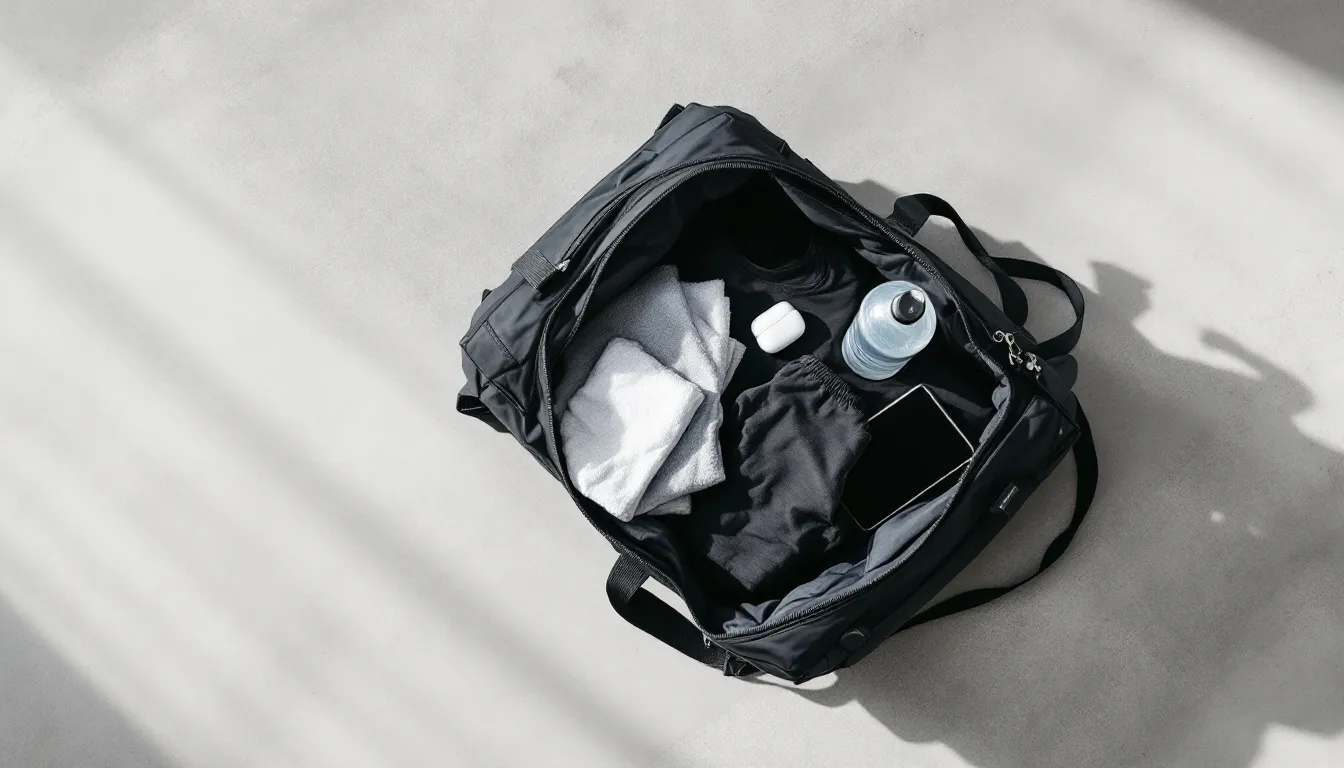
Your gym bag should contain exactly what you need and nothing you don't. The goal is a bag you can grab in 30 seconds and know you're covered for the full session, from warm-up to post-workout change.
Here's what earns a permanent spot, and why each item pulls its weight:
- Water bottle (minimum 750 ml, ideally 1 litre). Hydration affects performance faster than most people expect. A large reusable bottle means you don't have to leave equipment mid-set to refill a small one.
- Training shoes. Your everyday sneakers are built for walking, not lateral movement or loaded squats. A dedicated training shoe, worn only at the gym, retains its support and sole structure for far longer.
- A change of underwear. Post-workout, moisture-wicking performance fabric becomes a sweaty, bacteria-friendly environment. Carrying a fresh pair is basic hygiene and makes the commute home significantly more comfortable.
- Gym towel. Most gyms require one for equipment etiquette. A compact microfibre version dries fast, takes up minimal space, and works better than the standard cotton variety.
- Resistance bands. Lightweight, versatile, and useful for warm-ups, activation work, and accessory exercises. They take up almost no space and fill gaps that machines and barbells can't.
- Lock (if your gym has lockers). Losing your wallet or phone mid-session is a mood-killer. A combination lock weighs almost nothing and solves that problem permanently.
- A pre-workout snack or post-workout protein. Timing your nutrition around training matters. A protein bar or shake mix takes up almost no room and means you're not scrambling for food on an empty stomach after a hard session.
- Deodorant and basic grooming. Gyms are social spaces. A small roll-on or stick keeps things civil for everyone around you.
- Earphones. Training with music or a podcast you actually enjoy measurably changes how a session feels. Wireless earphones with a secure fit are worth the investment.
- Notebook or training app. Tracking your lifts, sets, and reps is how you build progressive overload over time. If it's not written down, it doesn't count.
For the full breakdown with specific product suggestions and packing order tips, head to the men's gym bag essentials guide.
---
What to Wear to the Gym: Building a Performance Kit That Actually Works
What you wear to the gym directly affects how you perform and how comfortable you are during and after training. Start from the base layer up, because getting the foundation wrong makes everything above it worse.
Start with the Base Layer (Yes, Underwear Matters)
Your underwear is the most overlooked piece of gym kit. Nobody talks about it. Nobody packs a guide around it. And yet it's the layer sitting directly against your skin during your entire workout, including that heavy back squat where the last thing you need is a waistband riding north.
Fabric matters enormously here. Bamboo viscose, the material TBô builds around, is naturally moisture-wicking and temperature-regulating, which means it draws sweat away from the skin rather than trapping it. Cotton holds moisture. During a 60-minute session, that's the difference between comfort and a very unfortunate situation.
Construction matters just as much. Flatlock stitch construction lies flat against the skin instead of raised seams digging in under compression shorts or joggers. A no-roll waistband stays exactly where you put it, which sounds obvious until you've spent a set deadlifting with your waistband folded in half. Fit at the gym is a functional issue, not a vanity one.

The Midnight Essentials Boxer Brief 6-Pack
Quality base layer underwear is crucial for comfort during intense workouts. The Midnight Essentials Boxer Brief 6-Pack offers bamboo construction that wicks moisture and prevents chafing.
$156.00$78.00
Shop Now →Shorts or Joggers
Both work. The call depends on the session. Leg day in tight joggers with no stretch is unpleasant. A flimsy pair of shorts during weighted lunges doesn't give you much confidence. Look for four-way stretch fabric and a gusset cut that allows full range of motion. If you're squatting below parallel, this matters more than any other spec.

The Elevated Essentials Trunk 6-Pack
Versatile gym trunks are essential for any workout routine. The Elevated Essentials Trunk 6-Pack provides comfortable, durable options for training sessions and active recovery days.
$156.00$69.00
Shop Now →T-Shirts and Tops
A relaxed-fit performance tee is the workhorse of any gym wardrobe. Avoid stiff fabrics that restrict shoulder rotation during pressing movements. Moisture-wicking fabric keeps you cooler; it's a construction choice, not a marketing claim.
Footwear (Revisited)
Flat-soled shoes or purpose-built trainers for strength work. Running shoes, with their cushioned, raised heel, are specifically designed not to be worn under a barbell. The heel elevation shifts your centre of gravity in ways that matter a great deal when you're loading a squat or deadlift.
Sustainability is a genuine factor when building a gym wardrobe, not just a talking point. Higher-quality materials, like sustainable underwear for men made from certified bamboo viscose, hold up through repeated washing and extended use. Buying less and wearing better is a smarter financial strategy over 12 months.
---
How to Structure a Gym Workout Routine for Men
A good gym workout routine for men follows a clear structure: a warm-up, compound movements first, accessory work second, and a cool-down. Training frequency, progressive overload, and adequate recovery between sessions are what turn a routine into actual results.
The Session Template
Every session should follow the same basic arc, regardless of which muscle groups you're training.
Warm-up (5-10 minutes). Raise your heart rate, mobilise the joints you're about to load, and activate the primary muscle groups. A cold muscle under a loaded bar is an injury waiting to happen. Compound lifts first (20-35 minutes). Compound movements, meaning those that recruit multiple muscle groups simultaneously, should anchor every session. Squats, deadlifts, bench press, overhead press, rows, and pull-ups belong here. You perform them first because they demand the most neurological and muscular output. Fatiguing your stabilisers with accessory work and then attempting a heavy deadlift is a recipe for poor mechanics. Accessory work (15-20 minutes). Isolation exercises and smaller muscle group work fill in the gaps after the main lifts. Bicep curls, lateral raises, face pulls, calf raises. These matter, but they're not the main event. Cool-down (5-10 minutes). Static stretching, breathing, and a few minutes of reduced intensity movement help manage soreness and support recovery.Progressive Overload
This is the single most important principle in strength training. Progressive overload means systematically increasing the demand you place on your body over time. In practical terms: if you squatted 80 kg for 3 sets of 8 last week, you're aiming for 82.5 kg or an extra rep this week. Small increments of 2.5 kg per lift per week compound significantly over months.
Without progressive overload, you're exercising. With it, you're training.
Recovery Between Sessions
Each major muscle group needs roughly 48 hours to recover adequately before being trained again. That's why training the same muscle group on consecutive days tends to produce diminishing returns. Your body builds strength during recovery, not during the session itself.
Sleep, nutrition, and gut health all feed directly into recovery quality. The connection between men's gut health and recovery is often underestimated: a poorly functioning digestive system affects nutrient absorption, which affects how well you actually use the protein you're consuming.
Three sessions per week is a sustainable, effective frequency for most men who are building consistency as a beginner. Four to five sessions works well for intermediate trainees using a structured split.
---
Training Split Comparison: Which Routine Fits Your Schedule?
Your training split should match your available days, not an aspirational schedule you'll abandon by week three. Here's how the most common options compare.
| Split | Sessions Per Week | Best For | Sample Week | Key Trade-Off |
|---|---|---|---|---|
| Full Body | 3 | Beginners, busy schedules | Mon / Wed / Fri | Lower volume per muscle per session |
| Upper / Lower | 4 | Intermediate trainees | Mon-Tue / Thu-Fri | Requires consistent 4-day availability |
| Push / Pull / Legs (PPL) | 6 | Advanced or dedicated trainees | Daily with one rest day | High time commitment; recovery critical |
| Bro Split (one muscle per day) | 5 | Those who enjoy high volume isolation | Mon-Fri, one group each | Only trains each muscle once per week |
| 5/3/1 (strength focus) | 4 | Men prioritising compound strength | Four main lift days | Less hypertrophy variety; slow progression |
The full-body split is the most forgiving entry point. Three sessions per week allows 48 hours of recovery between each, fits most schedules, and still delivers real results when progressive overload is applied consistently. The upper/lower split adds frequency per muscle group and is the natural progression once full-body plateaus. PPL is effective but demands six sessions, which is a significant commitment for anyone with a full work week.
Choose the split you can actually do for 12 consecutive weeks. Consistency beats optimisation every time.
---
Pre-Workout Habits That Set Up Every Session
What you do in the 60 minutes before you train determines a significant portion of how that session goes. Nutrition, hydration, and a proper warm-up are the three variables you can control and they all have specific, practical targets.
Hydration
Drink at least 500 ml of water in the hour before training. You don't need a sports drink for a standard gym session. Plain water handles the job unless you're training for more than 90 minutes in heat. Arriving at the gym already mildly dehydrated is common and entirely avoidable.
Pre-Workout Nutrition
Eat a light, balanced snack 45-60 minutes before training. Aim for a combination of carbohydrate and protein: something like Greek yoghurt with fruit, a banana with peanut butter, or a small rice-based meal. This gives your body available fuel without blood still being diverted to digestion when you're under the bar.
Training fasted works for some men, particularly in the morning. If you find your performance drops without food, that's your signal to eat beforehand. Listen to the data your own sessions give you. Your gut health and workout performance are closely linked: a digestive system under stress absorbs nutrients less efficiently, which affects energy availability during training.
The Warm-Up
Spend 5-10 minutes on an active, movement-specific warm-up. Not a static stretch at the side of the room. Joint circles, bodyweight squats, band pull-aparts, and hip flexor work take ten minutes and meaningfully reduce the risk of a soft tissue issue that could sideline you for weeks. Skipping the warm-up is the most common form of false economy in training.
Leave your phone in your bag during the warm-up. You'll get more out of five focused minutes than fifteen distracted ones.
---
Recovery Is Training: What to Do After the Gym

Recovery is not the passive gap between sessions. It's where adaptation happens. What you do in the hour after training and the night that follows is as important as the session itself.
Post-Workout Nutrition
Consume 20-40g of protein within roughly 60 minutes of finishing your session. This gives your muscle tissue the amino acids it needs to repair and grow. Whole food sources work just as well as shakes: eggs, chicken, fish, Greek yoghurt, or cottage cheese. A shake is convenient, not mandatory.
Pair the protein with some carbohydrate to replenish muscle glycogen stores. A banana, rice, or oats alongside your protein source is practical and effective.
Sleep
Seven to nine hours of sleep per night is where the majority of muscular repair and hormonal recovery takes place. Training load and sleep quality are directly related: if you're regularly training hard on five hours, you are actively working against your own results. No supplement closes that gap.
Fabric and Comfort Post-Workout
Change out of your gym kit promptly after training. Prolonged contact with sweat-saturated synthetic fabric against skin creates conditions that lead to irritation and bacterial build-up. Natural moisture-wicking materials like bamboo viscose manage this better than polyester, but the principle holds regardless of fabric: get changed. Your skin and the people around you will both appreciate it.
The connection between how gut health affects recovery is worth reading if you're training consistently and not seeing the results your effort should produce.
---
Common Gym Mistakes Men Make (And How to Fix Them Fast)
The most expensive gym mistakes are the quiet ones. They don't cause immediate injury. They just slowly drain the return on every session you put in.
Here are five mistakes that appear repeatedly, and the straightforward fix for each:
1. Skipping the warm-up.Fix: Do a structured 5-10 minute warm-up before every session, including active mobility and muscle activation relevant to the day's main lifts. Non-negotiable.
2. Chasing weight instead of form.Fix: Drop the load by 20%, perfect your range of motion, and rebuild from there. A tight squat at 60 kg builds more muscle than a collapsed one at 100 kg.
3. Training without a plan.Fix: Write your session down before you arrive. Know your sets, reps, and target weights. Wandering between machines is not a training routine. For actionable structure on tips for staying consistent as a beginner, that guide covers the habit side in detail.
4. Ignoring recovery and sleep.Fix: Treat your sleep window as a non-negotiable training tool. Aim for 7-9 hours. Reduce training volume before reducing sleep duration.
5. Wearing the wrong base layer.This is the mistake no other gym guide mentions, and it's costing men real comfort and performance. Your underwear is directly against your skin for the entire session. Cotton retains moisture and bunches under compression wear. A rolled waistband during a loaded movement is distracting at best and dangerous at worst if it breaks your focus mid-lift.
The fix is specific: choose underwear built for movement. A no-roll waistband stays anchored through every rep. Flatlock seams don't dig into your skin under tight-fitting shorts. Bamboo viscose actively wicks moisture away from the body, keeping you drier throughout the session. This isn't a luxury feature. For a one-hour training session, it's a practical requirement that most men discover by accident when they finally wear something that actually works.
---
Building a Sustainable Gym Kit: Buy Less, Wear Better
A sustainable gym kit is a practical strategy before it's an ethical one. Buying fewer, higher-quality items that last through hundreds of training sessions and wash cycles costs you less over 12 months than replacing cheap kit every few months.
The fast fashion approach to gym wear looks economical at the point of purchase. A three-pack of polyester tees for a low price seems like a good call until the fabric pills after eight washes, the seams separate, and you're back buying another three-pack. The cost per wear calculation almost always favours quality.
The same logic applies to base layers. Sustainable underwear for men made from certified bamboo viscose holds its structure, softness, and moisture-management properties through repeated washing in a way that cheap cotton and low-grade synthetic blends don't. You wash your gym underwear frequently. The material needs to withstand that.
The environmental dimension is a genuine bonus, not a marketing hook. Lower-quality garments are replaced more often, generating more textile waste. Buying once and wearing longer produces a smaller material footprint by simple arithmetic.
Building a gym kit around durability also simplifies your decisions. When every piece of your kit works reliably, you spend less mental energy on what to wear and more on training. That's the opposite of fast fashion, and it's a better deal in every direction.
---
Frequently Asked Questions About Gym Essentials for Men
What are the most important gym essentials for guys?The non-negotiables are a water bottle, training shoes, a gym towel, and appropriate gym clothing including a moisture-wicking base layer. Everything else supports performance once those foundations are covered. The full breakdown is in the full gym bag packing guide.
What should men wear to the gym?Men should wear performance-fit shorts or joggers with four-way stretch, a moisture-wicking top, and dedicated training footwear. The often-skipped detail is the base layer: underwear made from bamboo viscose or similar moisture-managing fabric performs significantly better than cotton during training.
What is a good gym workout routine for men who are beginners?A full-body routine, three sessions per week on non-consecutive days, is the best starting point for most beginner men. Each session should include two to three compound movements with progressive overload applied weekly, alongside a structured warm-up and cool-down.
How many days a week should men go to the gym?Three to four sessions per week is the practical sweet spot for most men. This allows each major muscle group at least 48 hours of recovery between sessions while accumulating enough training volume to produce consistent progress.
What is the most overlooked item in a gym bag?A change of underwear. Most men pack a change of t-shirt and shorts but forget that the base layer is the piece with the highest contact area during the entire session. Carrying a fresh pair built from moisture-wicking fabric makes the post-gym period significantly more comfortable and hygienic.
---
The Bottom Line on Gym Essentials for Men
A better gym workout routine for men comes down to four things done well: a properly packed bag, a performance kit that starts at the base layer, a structured training routine with progressive overload, and recovery habits that treat rest as part of training.
Get the gear right, dress for the session rather than the aesthetic, train with a plan, and sleep like it matters. Because it does.
On the kit front: if there's one upgrade most men haven't made, it's the base layer. TBô's bamboo-viscose basics are built specifically for exactly this: moisture-wicking, flatlock-seamed, no-roll waistbands that stay put through every rep. Start there and build the rest of your kit around something that actually works.
For the full packing list, the men's gym bag essentials guide has you covered. And for the base layer specifically, sustainable bamboo underwear for men is where Agent Terry would start.
Train well. Dress smarter. And for the love of squats, sort your underwear out. 🏋️
0 comments